Back on the Blog

The darn pandemic knocked me out of my blogging stride, but I’m hoping (fingers crossed) to get back on the tractor to post a lot more again this year, because it’s been busy on the farm, with fun plans ahead!

Robin's nest with eggs on truck bumper

We’ve been digging into finding our farm’s rhythm and moving beyond what felt like a constant start-up phase. The big news is that we finally were considered “established” enough to be able to take out an infrastructure loan, and over the past fourteen months built a new heated prop house, a third high tunnel, and an equipment shed (the first structure on the farm that could classify as a “barn”). Less visually exciting, we opened up enough vegetable fields that we can cover crop and rest half the farm every season, and thanks to four seasons with more staff continuity (our team is always awesome, it’s just an extra bonus when folks stay for more than a year) we were able to get some smaller but key systems into place.

And I didn’t share enough of it here!

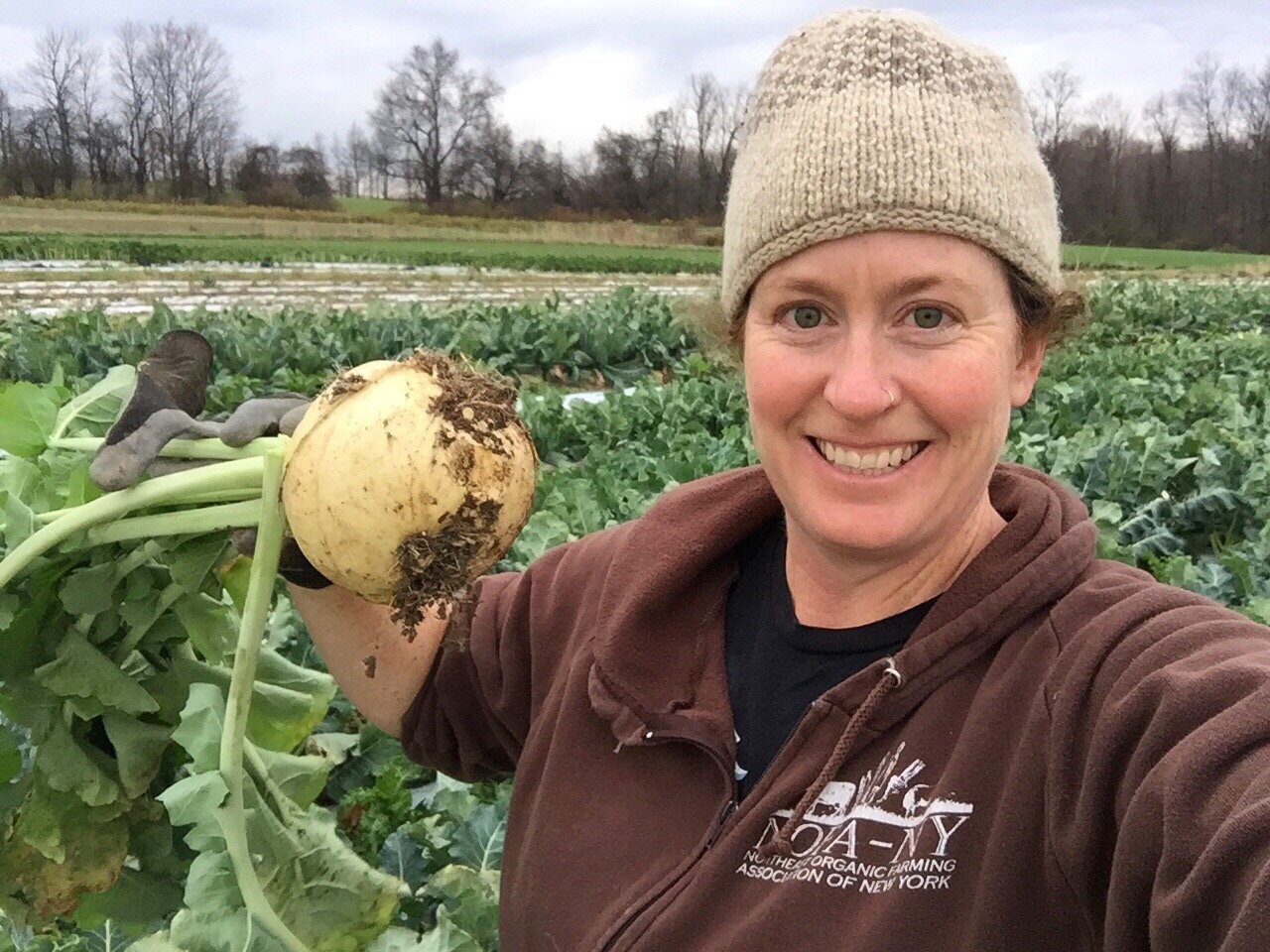
Harvesting beets in the morning

The truth is that the reason I don’t blog or post as much as I want to is that I find social media grindingly anxiety producing. In my own little bubble, I’m happy to plod along and things generally seem good or at least do-able.

But I always feel like when I go online to share something, everything is so superlative. (I’m not dissing farms that are awesome on social media – I love seeing and hearing how you all do things!)

But hearing and seeing enough of: “If you haven’t planted XXX by now, it can’t grow this year!” or “Real farmers make $$$, and if you don’t than you are just playing at a hobby” or “Organic farming is just a way for farmers to bamboozle you out of your hard-earned money” pops my bubble and I grump around the fields the rest of the day.

I care enough to be irritated, but not so much that I want to waste time on rage responding, so I just start avoiding blogging or social media. It’s not that I don’t want to share the good things that are happening here at Hartwood or the beauty in the world around me, but more like social media feels like constant multi-tasking in a performative manner (like multi-tasking while you are being judged at how you switch between things?). And multi-tasking and performing are basically the two things I hate the most!

Anyhow, my goal this year is to get over that feeling so we can share more about what’s happening at the farm (and how we interface with the wider world). 2022 is shaping up to be the year of streamlining the hundred tiny projects that we what we do a little bit better, and making sure that all our veggies taste even better. And hopefully I can suck it up and multi-task enough to get some great pictures of it from here to you!

Holding an armful of UPick flowers

What Keeps Farmers Up at Night?

I know, this is supposed to be my week for a happy blog, and I do have some in the works! But, I can’t stop thinking of this newsletter article from yesterday, so my phobias are bumping our happy greenhouse stories to next week.

Here’s the link to the newsletter that raised my paranoia level five notches.

(And yes, maybe I’d be less stressed if I didn’t spend my downtime during a pandemic reading about climate change, but I can’t help myself. It’s a problem I have.)

Let’s get back to HAIL. And insurance.

Ever since we got hammered at the farm in 2017, at the back of our heads every single time the sky turns dark is the question—is this the storm that destroys everything? Part of the decision to buy another high tunnel this year was wanting to put more high value veggies under at least a little bit of protection.

Hail is a weird problem because it’s so spotty and unpredictable. We might get it at our farm while our neighbor doesn’t. Once in 2016 after our big storm, we drove over to Greyrock Farm for an event, which is four and a half miles as the crow flies. Their fields were fine and ours were fine, but between the two farms, we drove through smashed branches and stripped trees.

Calling out hail as America’s most under-rated climate risk resonated with me, because even with Covid and heavy snow in May and random frosts and windstorms, hail is the one thing that deeply scares me as a farmer.

What do you do when the sky opens up like this?

Photo by Matt Morag in Tri State Neighbor article showing hail damage in South Dakota

Photo by Matt Morag in Tri State Neighbor article showing hail damage in South Dakota

Or this picture from poor Guadalajara in 2019 when they got three FEET of hail (picture from the NY Times, click on it for the story link)? WTH?

There’s nothing you can do. Heck, even with greenhouses and plant covers, there’s no protection for hail like that.

The newsletter highlighted insurance companies (specifically, car dealership insurers) and how they are collecting more data about the expansion of hail damage in the US. This brings me to insurance, a question we get from folks pretty regularly.

Yes, federal crop insurance is a thing, but it’s not as easy or straightforward as getting a policy for a house burning down, workers getting hurt, coolers failing and turning veggies to mush, or the delivery van getting into an accident (all of which we do have reasonable insurance for).

For crops, there are just so many factors that are part of insurance and of payouts—did the farm do what needed to be done to prevent a crop failure? Was there a real disaster event? Can you prove it? What about crops that are worth more than others—is that radish bunch worth 25 cents or 3 bucks? How do you indemnify a situation with as much fundamental uncertainty as farming?

We are the sort of farm that it’s essentially impossible to insure in a system aimed at commodity agriculture because we just grow so many crops, all in small amounts compared to five thousand acres of wheat or a thousand acre apple orchard. Over two thirds of our veggies go to our great CSA members, which some insurers consider an uninsurable marketing arrangement (since there’s “risk” inherent in the CSA relationship). Other insurance options are based on past income, but even in non-CSA sales at market, farm income fluctuates based on when holidays fall and if it’s rainy at market and what’s going on in a community or down the road. Even now that we’ve been in business long enough to secure a policy, it seems like a bad deal to pay in to something that only covers losses once they hit 50% and then only pays 50 or 60 cents on the dollar after losses hit that point.

Rain, Rain, Go Away! This is from one of the wetter summers (when fortunately we had some tomatoes in the high tunnel as well!)

Rain, Rain, Go Away! This is from one of the wetter summers (when fortunately we had some tomatoes in the high tunnel as well!)

Instead, we cover up crops as best we can when the sky turns grey, replant when the clouds solidify into hail, trust that our members and customers understand if things happen (in 2017, we were relieved that most folks were cool buying and eating veggies with some hole action), and hope for the best as much as we can.

Which brings me at last to something I’ve been thinking about a lot this year, and that lies at the root of my hail fears: uncertainty.

Most of what is stressful or hard in farming is the constant uncertainty that underlies everything you do when working in a field that intersects with nature. We can do our best, but still might not have success. Sometimes there’s a freeze or hail or injury or just plain old crop failure. We hedge our bets, plan for the worst, and build in all sorts of protections and redundancies, but there is always risk and uncertainty.

I am a super uptight, type A person with anxiety issues that likes to plan and control for everything. I have absolutely no idea why I like farming and survived in this field all these years coexisting with the level of uncertainty farmers have every minute of every day (maybe it’s the beer or the ice cream?).

I never considered the ability of farmers to develop and practice coping skills around uncertainty as something positive. In fact, most of my adult life I’ve worked to be less anxious about uncertainty.

It’s only in a world now shaken up from Covid, where we can’t plan ahead like we used to, or feel confidence in knowing what’s coming, or be able to insure our way to a positive outcome, that I’m finally seeing that learning how to deal with disconcerting levels of uncertainty is a skill I guess I’m okay with having. But it’s also a series of fears, stresses, and experiences I wish that all you non-farmers out there could have been spared, because like hail, uncertainty sucks.

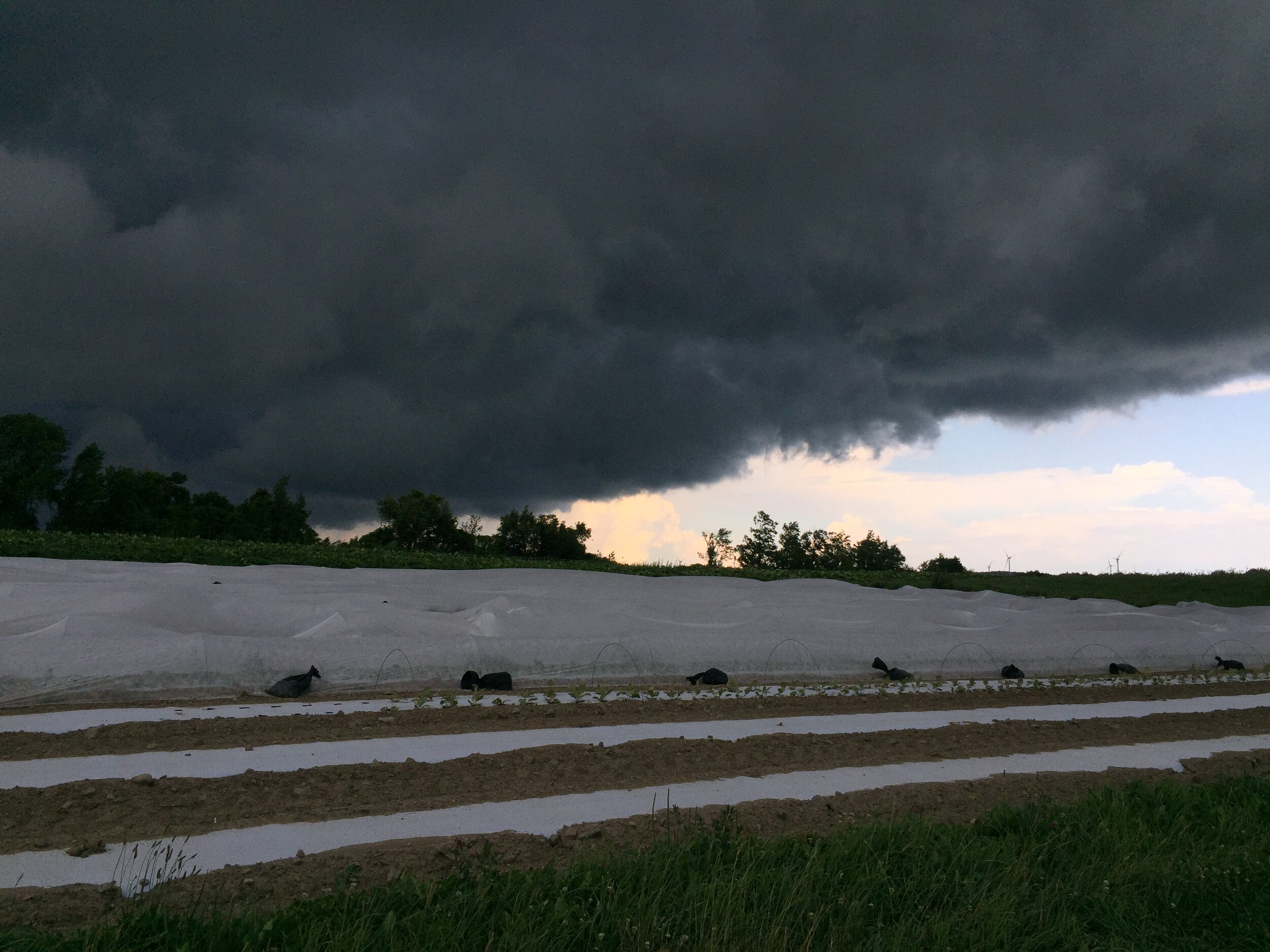
This was the scariest storm cloud of 2020, but it was all creepy menace, but not a mean field destroyer!

This was the scariest storm cloud of 2020, but it was all creepy menace, but not a mean field destroyer!

Walking a Mile in Others’ Muck Boots—Farmer Dramas and Impostor Syndrome

It’s January, which means it’s the season of farm conferences. In this pandemic year, it’s the season of a LOT more farm conferences than the one or two events we normally would attend in person, since all education is now online.

My monthly calendar looks like I’m back in school, with at least one class three or four days a week for the next couple months. Wherever I am on the farm, if I’m within Wi-Fi range and have my headphones on, I’m probably listening to a webinar.

One thing that I love about being farming is this sheer bulk of information we need to process, and the different things we can tweak to be just a little bit better. Every year, we use language and science, biology, geometry, chemistry, marketing, financing, graphic designing, accounting computer programing, and a truly staggering amount of algebra. (Seriously, diversified vegetable farms are algebraic machines—if you have x members who get 3 cucumbers a week and y members who get 4 cukes a week, and you get 2 cucumbers a foot for three weeks from one planting, calculate how many feet of cucumbers you need to guarantee 8 weeks of adequate member cucumberization…)

No cukes, but tons of other algebraically derived peak summer veggies!

No cukes, but tons of other algebraically derived peak summer veggies!

It’s been one bright light this gloomy winter to have the chance to refresh old ideas and hear from farmers with new research—even if we just learn just one new thing from a two-hour class, that can really help us get better food from our farm to our members. So far, I’ve learned a new member database system (with free software to boot!), alternative long-term storage strategies for keeping winter squash, and that we can store a wider range of crops for winter (radicchio and cauliflower, I’m gunning for you!).

Yet it’s also been frustrating to hear a bit of the absolutism that seems to reign now from our veggie fields up into government and industry.

Just like in the bigger world, us farmers get into hot dramas. (Bet you non-farmers didn’t know that!)

And maybe ours are even more intense than “normal” drama, because we’ve got opinions and they have ample time to germinate and grow/fester as we drive our tractors, push hoes, or wash carrots stuck alone in our own minds. I have seen people almost come to fistfights over soil management, watched dozens of arguments about pesticide use, seen friendships break up over grazing management (as well as two marriages end building greenhouses), and personally been told what a lousy farmer I am way too many times to count. I have a friend out of the dairy industry who swears it’s only us vegetable farmers that have drama—her theory being that we northern plant growers have too much darn time in the winter to stew, unlike the dairy farmers that wake up at 4am *every* day, and are constantly too tired to argue!

Rutabagas ain’t got no drama! We are excessively successful at long term rutabaga storage—let us know if you have a hankering!

Rutabagas ain’t got no drama! We are excessively successful at long term rutabaga storage—let us know if you have a hankering!

I wanted to write this particular blog as a boost to the other smaller farmers out there, as well as all you home gardeners, homesteaders, and backyard gardening wannabes, to encourage us all to work within our own systems and constraints and learn what works best for the land we are working with—which may not be what works best for others’ land! As a gardener/farmer, you are in the process of becoming the number one expert on your site, and your learned experience will give you guidance to help figure out your way of growing.

Because in farming, there is not one right way to do things, but rather a set of myriad possible paths that might fit your land, time, and financial needs. For some of us, that could be no till and deep soft beds tucked in every winter under 12 inches of leaves. For others of us, that might be growing in pots or plant protection under tunnels and greenhouses (pro-farmer tip for fellow Fenner-ins—leaves don’t stay where you put them up here!).

We farm outside of Syracuse, NY on the north edge of the Allegany plateau. It’s the northern end of hundreds of miles of hilly, rising high ground that sweeps up from the Appalachians and Pennsylvania, before dropping 1300 feet to the Great Lake plain half a mile north of our farm. It’s beautiful and green and rolling up here—a big sky filled with swirling clouds, roiling with winds coursing around and over or slapping against that escarpment.

Fenner does skies well (well, when we can see the sky through the snow these days).

Fenner does skies well (well, when we can see the sky through the snow these days).

Vegetable farming in Fenner is hard as heck. Because we are extra crazy (or maybe not that smart?), we are organic farmers, which makes things even harder. We couldn’t produce on our commercial scale if we weren’t darn good farmers. But some days (or seasons) the very act of trying to grow vegetables up here feels like we’re slamming our heads pointlessly against the wall.

In order to guarantee our CSA members and customers a high-quality product, we do use practices that I’d skip if I was growing in other, more mild conditions. We have high tunnels and row covers, and use some plastic mulches to keep our ground temperatures up, while minimizing soil compaction from the extreme rains of recent years. We rotate fields, try to keep our ground covered (even if only with plastic sheeting), plant soil building cover crops, and encourage air flow and healthy plants. And with all these steps, our land and the effectiveness of our farm systems are slowly but steadily growing better each year.

And yet, even against the lens of that slow success (and knowing that just by surviving as a small farm these days is a success), I am constantly doubting myself, especially when I weigh our farm against growers in more mild climates. (There’s that darn impostor syndrome!)

This is not even a scary cloud for us. Scary clouds are spinning or would already be smashing all the tender veggies up with hail by this point!

This is not even a scary cloud for us. Scary clouds are spinning or would already be smashing all the tender veggies up with hail by this point!

We get asked endlessly about expansion and doubling our CSA and growing wholesale. Most times it’s helpful suggestions of people that want to work with us or see us do more or reach more markets. This last year some of those asks were more in the upset range, after we ran out of capacity so quickly to sell any more CSA shares.

Our truth is that we are good enough farmers to know our limits. Sure, maybe we dream too small. Maybe we should go back and manage farms on better land for someone else.

But there’s also such appeal of learning to do something hard and becoming good at it, because sometimes life is hard, and it would be good if we are able to grow local food for community futures in all regions (even our windy, extreme one).

I like the constant learning and challenge of evolving the farm systems as new technology and research comes online. I appreciate how the internet and greater connectivity helps communities that have been growing much longer on this continent share how they manage and adapt. There’s so much to learn and try out there, with eons of agricultural systems already tested and continually being re-tested, that it seems a poor plan to get stuck in one immutable this-is-how-thee-must-grow system.

And I also feel like there’s lots to learn from farms like ours, growers that are plunked down onto the more challenging spots but who still make things work. These past two years, the weather for much of the eastern US was lousy. The weather for us on the escarpments of Syracuse was “normal,” in that it was also lousy, but within our expected range of weather. This isn’t to say we don’t struggle or aren’t terrified of hail and windstorms, but that we are used to those challenges. Our farm systems are set up to operate a commercial organic vegetable operation knowing that we will likely get 4 inches of rain in an hour, 60mph winds (and weeks of 20mph standard breezes), and either eight weeks of daily rain or not a drop of rain. Drought, heat waves, never cracking 80, going from 30 to 90 in a week, heavy snow in mid-May? Been there, done that.

So this is my call for all us farmers and gardeners—to feel more confident in how we grow on our spots, to feel open to constantly learning and questioning and seeking new ways, but to not be judge-y about others who are finding their own ways.

Do you have some farm or garden tactics that you don’t having to use, but really make a difference on your site? What are your favorite farming education resources? I’m partial to NOFA-NY (their conference is running this week) and Cornell Small Farms. And we are always happy to talk with farmers trying to learn how to deal with wind (our specialty!)

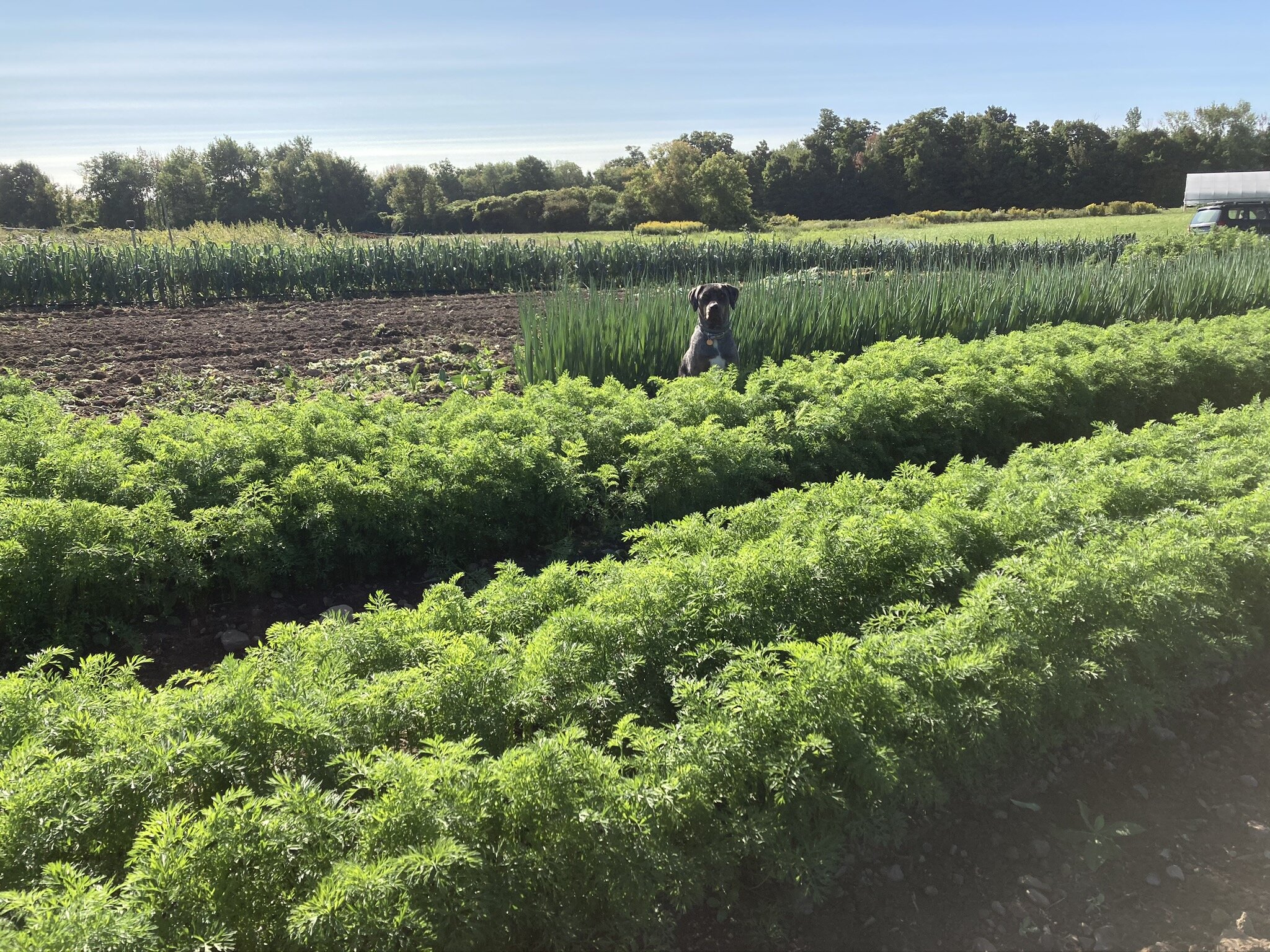
Another perfect day in this drought summer (we LOVE dry summers here), where Princess Peapod cruises for shade.

Another perfect day in this drought summer (we LOVE dry summers here), where Princess Peapod cruises for shade.

Technology is Hard (and other Hartwood Farm curses)...

Every year my new year’s goal is to publish more blogs. (Note that I didn’t say “write” more blogs, because I tend to write plenty, but then not publish them for being off topic, too dark, or not things that folks want to read.

This year we are retooling our blog for real though, adding our CSA newsletters to it, as well as recipe posts, the normal farm blogs, and my more random farm blogs (which I’m going to tag “muddy thoughts” even though I really want to call them “dirty thoughts.”

I’m kicking off this resolution with the big issue on the farm this week, seemingly random as it is:

DO YOU KNOW HOW MUCH TECHNOLOGY SMALL FARMERS HAVE TO LEARN TO USE???

IMG_4961.JPG

So two days ago, we were supposed to start selling CSA shares to returning members.

Are you a returning member who is just now thinking, “Oh yeah, I didn’t get an email about that, did I?”

Well, it wasn’t for lack of trying.

This fall, like every fall, I put in a few days and really troubleshooted how to make the signup process better and what platform to use (that’s part of why we were encouraging pre-registration—to get it all set up to save you time!).

On Monday, I finalized everything and then…. (drumroll please)… the shares didn’t show up.

Different browser tried and they popped up, and then disappeared, reappeared, disappeared and so on. Seven browsers, 50,000 window refreshments, twenty-four hours, and countless tech emails later, the shares still weren’t visible to us 75% of the time, but apparently are quite visible and on sale in Canada (where the host operation for our online store is located), and for the one sole member that successfully navigated the system (are you the human antidote to our tech issues?).

This is par for our course/curse. Matt thinks I should give up farming and become a hacker, because every tech “solution” I touch gets fried.

This was in NH, when it flooded at market every week for a summer! When it rains, it pours?

This was in NH, when it flooded at market every week for a summer! When it rains, it pours?

The most spectacular manifestation of the curse (any accountants reading this, please cover your ears) ended in us using only paper and Excel old school ledgers for business accounting (my grandfather would be proud).

Do we know that online systems exist? Are there 500 courses a year to help farmers get set up in Quick Books? Did we actually spend a lot of money with a consultant years ago to do just that? Sure we do/did.

My tech curse power is SO STRONG that somehow our teeny tiny farm’s data on Quick Books Online intermingled with data from a multi-million dollar company in Florida. Before the QB corporate office had to actually shut down our account to entirely rewrite code for THREE WEEKS, they spent a full week trying to convince me that I did in fact have a business in Florida with seven employees and fourteen credit cards (all of who I had full access to at that time) that I must have somehow forgotten about. Even with the re-coding, Quick Books never worked quite right again for us.

Which is unfortunate, because in the world today, using every tool you can to be effective at managing, communicating, and selling online is super important, even if we only focused on our very in-person, connected with our customer/community product.

Most farms our size do our own web design, ecommerce, accounting, bookkeeping, marketing, graphic design, social media, emailing, and so on. On one hand, it’s kind of fun to get to do so many different things—I actually love getting to play with graphics and work on the website.

But on the other hand, when the curse strikes, everything gets so frustrating that it makes me yearn for the days of the good old hand drawn CSA brochures and Microsoft Publisher!

Look at our cute paper newsletter from back in the day! Village Roots is still going strong…

Look at our cute paper newsletter from back in the day! Village Roots is still going strong…

Last night I was lucky to be a part of group of women in business hearing how others work around all these programs and challenges. Karli of Head and Heal (folks, have you tried any of their CBD products? They are amazing—Matt finds they help with sleep and they ease my tendonitis. You can snag them a lot of places locally, including at 20 East in Cazenovia) shared some of the tech they use and how they’ve addressed some of these challenges.

It was a good end to a day that had me bouncing my head on the computer keyboard to hear that other farms and businesses are in the same situation at times as us, even without a curse of their own.

And it inspired me to wake up at 6am this morning and start ALL OVER again on our 2021 signups, with yet another system, and I think it might be working now. If not, like in past years, we’ll have a paper signup link for folks who because of your own curse or not, want to go old school and register via paper.

Returning member signup runs through January and theoretically works on our website. Folks on the waitlist can sign up in February, and for potential new members, registration opens in March. You can also click here to get added on the waitlist. And thank you all for your patience—we look forward to the very analog act of getting veggies to you!

Like I said, I love doing silly graphics!

Like I said, I love doing silly graphics!